












Acetylenic spacers in phenylene end-substituted oligothiophene core for highly air-stable organic field-effect transistors
Literature Information
Publication Date
2010-02-24
DOI
10.1039/B923352K
Impact Factor
3.676
Authors
Abdou Karim Diallo, Christine Videlot-Ackermann, Philippe Marsal, Hugues Brisset, Frédéric Fages, Atsufumi Kumagai, Noriyuki Yoshimoto, Françoise Serein-Spirau, Jean-Pierre Lère-Porte
View Original
Abstract
Two thiophene–phenylene semiconductors, bis(2-phenylethynyl) end-substituted oligothiophenes (diPhAc-nTs, n = 2, 3), were synthesized and studied with respect to their optical, electrochemical, structural and electrical properties. The optical and electrochemical properties of the oligomers in solution were investigated by UV-vis absorption and photoluminescence spectroscopies, and cyclic voltammetry. High vacuum evaporated thin films were investigated by optical absorption, X-ray diffraction and AFM, and implemented as p-type semiconducting layers into organic thin-film transistors (OTFTs). A comparative study in solution and in the solid state with distyryl-oligothiophenes (DSnTs, n = 2, 3) reveals the great influence of acetylenic (–CC–) vs. olefinic (–CC–) spacers in thiophene–phenylene derivatives on electronic structure, physical properties, and device efficiencies. Substituting olefinic for acetylenic π-spacers in terthiophene-based conjugated semiconductors leads to one of incontrovertible attributes of OTFTs for low cost applications, a high mobility at low substrate temperature (Tsub) i.e. typically 25 °C. Fine-tuning in the HOMO/LUMO levels by reducing the HOMO level introduces increased air-oxidation strength of thin films where OTFTs provide exactly the same hole mobility value after 100 days in air. All the results suggested that introduction of carbon–carbon triple bonds provided an efficient route to highly air-stable organic thin film transistors.
Recommended Journals
Related Literature
The transport properties of silicon and carbon nanotubes at the atomic scale: a first-principles study
Shizheng Wen, Likai Yan, Caixia Wu, Chunmei Zhang, Min Zhang
2016-07-21
Paper
DOI: 10.1039/C6CP03393H
Effects of the acceptor unit in dyes with acceptor–bridge–donor architecture on the electron photo-injection mechanism and aggregation in DSSCs
Ximena Zarate, Francisca Claveria-Cadiz, David Arias-Olivares, Angela Rodriguez-Serrano, Natalia Inostroza, Eduardo Schott
2016-08-02
Paper
DOI: 10.1039/C6CP04662B
Quantum phase transitions in Sn bilayer based interfacial systems by an external strain
Li Chen, Qiandong Zhuang, Yeqing Chen, Changmin Shi, Dongchao Wang
2016-08-03
Paper
DOI: 10.1039/C6CP04534K
Solvent effects on the properties of hyperbranched polythiophenes
Juan Torras, David Zanuy
2016-08-11
Paper
DOI: 10.1039/C6CP04812A
How do random superficial defects influence the electro-oxidation of glycerol on Pt(111) surfaces?
Pablo S. Fernández, Polina Tereshchuk, Camilo A. Angelucci, Janaina F. Gomes, Amanda C. Garcia, Cauê A. Martins, Giuseppe A. Camara, María E. Martins, Juarez L. F. Da Silva, Germano Tremiliosi-Filho
2016-08-16
Paper
DOI: 10.1039/C6CP04768H
Characterizing a nonclassical carbene with coupled cluster methods: cyclobutylidene
Xiao Wang, Jay Agarwal, Henry F. Schaefer III
2016-08-09
Paper
DOI: 10.1039/C6CP03513B
Retracted Article: Comprehensive insights into the charge dynamics process and excellent photoelectric properties of heterojunction solar cells
Xiangyang Liu, Shun Wang, Haiwu Zheng, Xiuying Cheng, Yuzong Gu
2016-07-27
Paper
DOI: 10.1039/C6CP02656G
Empirical in operando analysis of the charge carrier dynamics in hematite photoanodes by PEIS, IMPS and IMVS
David Shai Ellis, Hen Dotan, Avner Rothschild
2016-08-01
Perspective
DOI: 10.1039/C6CP04683E
Effect of aromatic ring fluorination on CH⋯π interactions: microwave spectrum and structure of the 1,2-difluorobenzene⋯acetylene dimer
Anuradha G. Akmeemana, Justin M. Kang, Rachel E. Dorris, Rebecca D. Nelson, Ashley M. Anderton, Rebecca A. Peebles, Sean A. Peebles, Nathan A. Seifert, Brooks H. Pate
2016-08-17
Paper
DOI: 10.1039/C6CP04737H
You might also like
Compound Q&A
Is 2-(2-chloroacetamido)-3-phenylpropanoic acid (CAS: 7765-11-9) safe?
2-(2-Chloroacetamido)-3-phenylpropanoic acid (CAS: 7765-11-9) is generally consi...
7765-11-92-(2-chloroacetamido...
Compound Q&A
Is 2-(Benzyloxy)-5-bromobenzoic acid (CAS: 62176-31-2) safe?
2-(Benzyloxy)-5-bromobenzoic acid can be handled safely if appropriate precautio...
62176-31-22-(Benzyloxy)-5-brom...
Compound Q&A
What is (4-Methyl-1,2,5-oxadiazol-3-yl)methanamine hydrochloride (CAS: 1159825-48-5)?
(4-Methyl-1,2,5-oxadiazol-3-yl)methanamine hydrochloride is a chemical compound ...
1159825-48-5(4-Methyl-1,2,5-oxad...
Compound Q&A
What is 2-(5-Hexylthiophen-2-yl)-4,4,5,5-tetramethyl-1,3,2-dioxaborolane (CAS: 917985-54-7)?
2-(5-Hexylthiophen-2-yl)-4,4,5,5-tetramethyl-1,3,2-dioxaborolane (CAS: 917985-54...
917985-54-72-(5-Hexylthiophen-2...
Compound Q&A
Are there alternatives to 4-(8-Methyl-9H-1,3-dioxolo[4,5-h][2,3]benzodiazepin-5-yl)benzenamine (CAS: 102771-26-6) in synthesis?
While 4-(8-Methyl-9H-1,3-dioxolo[4,5-h][2,3]benzodiazepin-5-yl)benzenamine (CAS:...
102771-26-64-(8-Methyl-9H-1,3-d...
Compound Q&A
What is the market or research trend for tert-butyl 3-hydroxy-4,5,7,8-tetrahydro-2H-pyrazolo[3,4-d]azepine-6-carboxylate (CAS: 851376-80-2)?
The market for tert-butyl 3-hydroxy-4,5,7,8-tetrahydro-2H-pyrazolo[3,4-d]azepine...
851376-80-2tert-butyl 3-hydroxy...
Compound Q&A
How should waste containing 3,5-Diamino-1H-pyrazole-4-carbonitrile (CAS: 6844-58-2) be handled?
Waste containing 3,5-Diamino-1H-pyrazole-4-carbonitrile (CAS: 6844-58-2) should ...
6844-58-23,5-Diamino-1H-pyraz...
Compound Q&A
How is (6-Fluoro-3-pyridinyl)boronic acid (CAS: 351019-18-6) typically synthesized?
(6-Fluoro-3-pyridinyl)boronic acid can be synthesized through the reaction of 6-...
351019-18-6(6-Fluoro-3-pyridiny...
Compound Q&A
What industries use Dibenzyl carbonimidoylbiscarbamate (CAS: 10065-79-9)?
Dibenzyl carbonimidoylbiscarbamate (CAS: 10065-79-9) finds applications in vario...
10065-79-9Dibenzyl carbonimido...
Compound Q&A
What is the market or research trend for (beta,beta,2,3,4,5,6-~2~H_7_)Phenylalanine (CAS: 74228-83-4)?
The market for (beta,beta,2,3,4,5,6-~2~H_7_)Phenylalanine (CAS: 74228-83-4) is g...
74228-83-4(beta,beta,2,3,4,5,6...
Source Journal
Physical Chemistry Chemical Physics

CiteScore:
5.5
Self-citation Rate:
10.3%
Articles per Year:
3036
Physical Chemistry Chemical Physics (PCCP) is an international journal co-owned by 19 physical chemistry and physics societies from around the world. This journal publishes original, cutting-edge research in physical chemistry, chemical physics and biophysical chemistry. To be suitable for publication in PCCP, articles must include significant innovation and/or insight into physical chemistry; this is the most important criterion that reviewers and Editors will judge against when evaluating submissions. The journal has a broad scope and welcomes contributions spanning experiment, theory, computation and data science. Topical coverage includes spectroscopy, dynamics, kinetics, statistical mechanics, thermodynamics, electrochemistry, catalysis, surface science, quantum mechanics, quantum computing and machine learning. Interdisciplinary research areas such as polymers and soft matter, materials, nanoscience, energy, surfaces/interfaces, and biophysical chemistry are welcomed if they demonstrate significant innovation and/or insight into physical chemistry. Joined experimental/theoretical studies are particularly appreciated when complementary and based on up-to-date approaches.
Recommended Compounds
![(1S)-1,5-Anhydro-2-O-alpha-L-arabinopyranosyl-1-[5-hydroxy-7-({6-O-[3-(4-hydroxy-3-methoxyphenyl)propanoyl]-beta-D-glucopyranosyl}oxy)-2-(4-hydroxyphenyl)-4-oxo-4H-chromen-6-yl]-D-glucitol structure](https://static.chemtradehub.com/structs/225/2252345-81-4-bcff.webp "(1S)-1,5-Anhydro-2-O-alpha-L-arabinopyranosyl-1-[5-hydroxy-7-({6-O-[3-(4-hydroxy-3-methoxyphenyl)propanoyl]-beta-D-glucopyranosyl}oxy)-2-(4-hydroxyphenyl)-4-oxo-4H-chromen-6-yl]-D-glucitol structure")
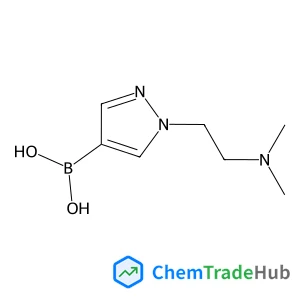
(1-(2-(Dimethylamino)ethyl)-1H-pyrazol-4-yl)boronic acid
CAS Number:
1086063-73-1
Molecular Formula:
C7H14BN3O2
![2-[(E)-(2-Methoxyphenyl)diazenyl]-3-oxo-N-(2-oxo-2,3-dihydro-1H-benzimidazol-5-yl)butanamide structure](https://static.chemtradehub.com/structs/821/82199-12-0-f1d0.webp "2-[(E)-(2-Methoxyphenyl)diazenyl]-3-oxo-N-(2-oxo-2,3-dihydro-1H-benzimidazol-5-yl)butanamide structure")
2-[(E)-(2-Methoxyphenyl)diazenyl]-3-oxo-N-(2-oxo-2,3-dihydro-1H-benzimidazol-5-yl)butanamide
CAS Number:
82199-12-0
Molecular Formula:
C18H17N5O4
Recommended Suppliers





Disclaimer
This page provides academic journal information for reference and research purposes only. We are not affiliated with any journal publishers and do not handle publication submissions. For publication-related inquiries, please contact the respective journal publishers directly.
If you notice any inaccuracies in the information displayed, please contact us at support@chemtradehub.com. We will promptly review and address your concerns.